Wednesday, 2 October 2019

The King of Comedy (1980)

Director: Martin Scorsese
Story: Paul D. Zimmerman
Cast: Robert De Niro, Jerry Lewis, Sandra Bernhard
Time: 109 minutes
Bottom-line: Not a comedy after all, but rather a reality bite

Martin Scorsese goes out of his normal line of filmmaking and directs the satirical dark comedy, The King of Comedy. A film very poorly received at the box office on initial release (grossing only $2.5 million against a $19 million budget), the film eventually gained praise and recognition in the coming years and, in my opinion, showcases one of De Niro’s best performances.

Better to be king for a night, than a shmuck for a lifetime.
Rupert Pupkin (De Niro) is an aspiring stand-up comedian, desperate for a “big break” in his career. He is a stage-door autograph hound, who gets a chance to share a ride in the car of Jerry Langford (Lewis), an immensely popular talk show host. He tries to convince Jerry to give him a chance on his show, after evaluating his recorded performance. However, he is continuously rejected by Jerry’s office staff, and finally by Jerry himself, to the point where Rupert reaches his breaking point. He partners with another hard-core fan of Jerry, Masha (Bernhard), and abducts Jerry at gunpoint, agreeing to release him if Rupert gets a chance to appear on the talk show. Does he finally get his “big break”?
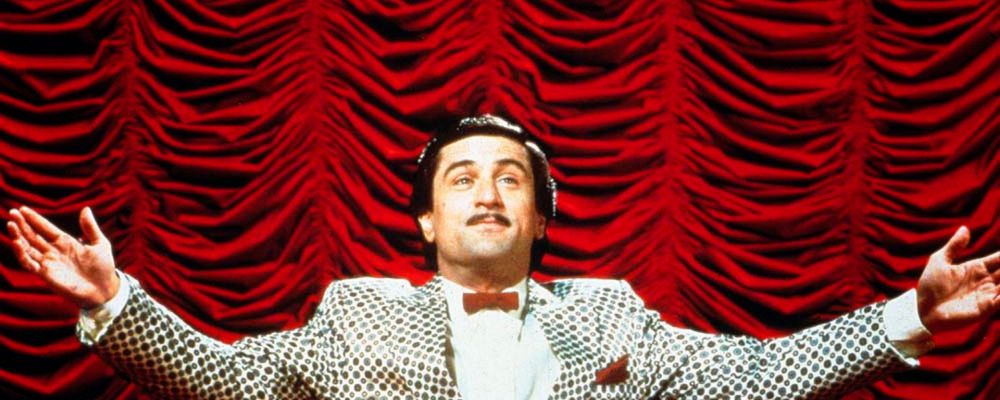
De Niro as Pupkin

All of us – at some point or the other – want to be famous; we at least want our “fifteen minutes of fame”. How desperate we are to achieve this is what defines what we do. Here, we see the ultimate case of obsession: a man who lives in a fantasy world where he is famous, more than he lives in the real world; a man who does not even realise that he is being rejected, time and time again. The story and direction are so beautifully done that you do not know whether to laugh or pity the character of Pupkin – kind of like the character of The Tramp in City Lights. As I said, this is not a film that makes you laugh; it is, in fact, depressing to some extent, to see a man struggle to achieve his dreams when virtually nothing and no one is supporting him.
 
Lewis as Langford
In many ways, the overall course of the story is similar to that of Taxi Driver: a man determined to do something, he’s alone with no one to support him, and when all the orthodox methods fail and he reaches his breaking point, he has to take extreme steps. Both Travis Bickle and Rupert Pupkin live in a world of imagination, and, like the climax of the 1976 film, whether the ending is a fantasy or not is for us to decide. Though the awards don’t reflect the fact, De Niro’s performance is easily one of the best of his career. The way he plays a character in constant denial, always putting a smile on his face hoping the moment will come – in a film all about showmanship – deserves praise. Among his eight collaborations with Scorsese, the latter considers the role of Pupkin to be his favourite.

Bernhard as Masha

This is a movie filled with characters each caring only about themselves, or as a critic put it: everybody's just waiting for the other person to stop talking so they can start, and this makes the film a reality bite. It is a wake-up call saying that no one is going to care about you unless you’re wealthy, powerful or famous. In a world filled with Jerry Langfords, you are going to have to be as eccentric as Rupert Pupkin to be “the King”, even if it’s only for fifteen minutes. Is it worth it? Or is it okay to “be a shmuck for a lifetime”? The King of Comedy might not be Scorsese or De Niro’s most well-known work, but watching it will influence you a lot.

My Rating: 3.5/5
Rotten Tomatoes rating: 90%

Saturday, 7 September 2019

Thank you for Smoking (2006)

Director: Jason Reitman
Screenplay: Jason Reitman (based on the novel by Christopher Buckley)
Cast: Aaron Eckhart, Cameron Bright, William H. Macy
Music: Rolfe Kent
Time: 92 minutes
Bottom-line: Highly impressive. Brilliant filmmaking on a sensitive topic

Michael Jordan plays ball. Charles Manson kills people. I talk. Everyone has a talent.
Currently, every movie, whether it is screened in a theatre or aired on TV, must advertise against smoking. “Smoking causes cancer; smoking kills” is probably the most repeated line on television. In 2006, Jason Reitman took Christopher Buckley’s book and decided to make a film on this extremely sensitive topic - smoking - and boy, did he pull off a success!

When you argue correctly, you're never wrong.
Meet Nick Naylor (Eckhart): handsome, stylish, and the best of the lot in his job. His job? A “lobbyist” and Vice President of “The Academy of Tobacco Studies”, which has been researching the relationship between tobacco smoking and lung cancer. Nick’s job is to report the findings of the Academy and also to question opposing health claims. He advises people to take their own choice when it comes to smoking. Nick’s method of arguing inspires his son, Joey (Bright). Nick’s friends - firearm lobbyist Bobby Jay Bliss (David Koechner) and alcohol lobbyist Polly Bailey (Maria Bello) call themselves the “Merchants of Death”. Meanwhile, Senator Finistirre (Macy) wants to promote the skull-and-bones warning sign on all cigarette packs. In a debate between Nick and the Senator, Nick gets a death threat from a caller. Nick is also destroyed by a seductive reporter, Heather Holloway (Katie Holmes), who exposes all his “true” intentions. How does Nick strike back?
 
Eckhart as Nick (right), and Bright as Joey
Few people on this planet know what it is to be truly despised. Can you blame them? I earn a living fronting an organisation that kills one thousand two hundred human beings a day.
Like Reitman’s future films, Thank you for Smoking also carries a distinctive style of filmmaking: the smart and witty lead character, the first-person narrative, the catchy opening sequence and a story revolving around a sensitive topic – this film deals with smoking, while his later films Juno and Up in the Air deal with teenage pregnancies and the need for human attachments, respectively – and a brilliant script. As much as we all know that cigarettes are harmful, it is still a business that will be running as long as people do smoke. The fact that the story is narrated from a person in the industry makes it interesting by giving us a new viewpoint.
 
William H. Macy as Senator Finisterre 
Nick constantly keeps emphasising the fact that it is our choice whether or not to get addicted to cigarettes. In 92 minutes, we see why Nick’s method of articulation makes him the best at what he is, and how the mere fact that he works for a cigarette company affects his relationship with his ex-wife and son. The second half of the film deals with Nick’s downfall after Heather’s report and how he bounces back. The humour comes from the way Nick convinces people that cigarettes aren’t as fatal as they seem to be, and how he teaches his son (and the viewers) the methods of arguing.
 
Holmes as Heather 
This role could well be Eckhart’s most stylish role and his best to date, second only to that of Harvey Dent perhaps. Full of charisma and humour, you know he is not kidding when he says his (character’s) talent is “to talk”. The scenes where he appears before the Senate committee and the one where he discusses the art of “arguing” with his son prove this. J.K. Simmons – who plays Nick’s boss – and William H. Macy have done well too, and, like in all Reitman films, their lines/dialogues give a big boost. 

So, while the main reason I watched the film was out of curiosity regarding the content, I found myself more than satisfied with what I got. This is one satire that you must not miss – smoker or not!

My Rating: 3.5/5
Rotten Tomatoes rating: 86%

Monday, 12 August 2019

The Descendants (2011)

Director: Alexander Payne
Screenplay: Alexander Payne, Nat Faxon and Jim Rash (based on the novel by Kaui Hart Hemmings)
Cast: George Clooney, Shailene Woodley, Amara Miller
Time: 115 minutes
Bottom-line: Touching and emotional, with powerful acting 

In Alexander Payne’s family drama, The Descendants, George Clooney pulls off his finest performance yet! The film is about a family’s hardships and how they deal with it, against a Hawaiian backdrop. The film co-stars Shailene Woodley, Amara Miller, Nick Krause and Matthew Lillard.

Matthew “Matt” King (Clooney) is a man with a number of problems on his hands at the moment – his wife is in a coma after a boating accident, he is the sole trustee of 25000 acres of land on Kauai island, and the trust expires in seven years due to the rule against perpetuities, so the rest of the family pressurises him to sell off the land for a fortune. His elder daughter, Alexandra (Woodley), is involved with drugs and older boys, while his younger daughter, Scottie (Miller) bullies others at school. On top of all this, Matt finds out that his wife had been cheating on him. With the help of his daughters, Alex’s friend Sid (Krause) and by keeping his own wits about, watch how Matt deals with all his problems, en route to being a better family man.

The story is set in Hawaii probably because it is to show the viewers that Hawaii is not exactly paradise for everyone. As Matt says in the opening lines of the film: “My friends on the mainland think just because I live in Hawaii, I live in paradise. We’re all here just shaking our hips and catching waves. Are they insane? How can they possibly think that our families are any less screwed up than theirs, our cancers less fatal, our heartaches less painful?” The plot focuses mainly on how Matt transforms into a caring family man, from being a business-oriented lawyer, learning from the painful experience of having to take care of his daughters without their mother. He has to overcome his emotional breakdown too when he learns about how his wife cheated on him. Matt learns more about himself and those around him when his wife can no longer move a muscle than he did when they were married.
Clooney as Matt (left), Woodley as
Alexandra (middle) and Miller as Scottie
After being awestruck by Clooney’s performance in Up in the Air, The Descendants was next on my list. This role amazed me even more, and, like I said, it could well be the best performance of Clooney’s career. You have seen him as a suave businessman (Up in the Air), a cunning thief (Ocean's Eleven), and even an attorney (Michael Clayton). Now he plays a family man, and he is so good at it too! Every expression is perfect, the body language is superb, and his lines are rendered with such passion and emotion. Look out for the scene where he confronts his wife’s lover and the final scene where he says the last goodbye to his wife. Another exceptional performance is by Shailene Woodley. The 19-year-old actress shows some really mature acting, filled with authentic expressions, and displaying all the characteristics of a typical teenager. This movie gives her a solid platform to expand her career. Miller, who plays the 10-year-old Scottie, has done quite well too.

The best part of The Descendants is that it shows the story of a normal man, not someone special. That is what makes the story all the more relatable. Watch the film for a touching story about a loving father/husband, and if you are a fan of George Clooney, get ready to experience a performance like you’ve never seen before!

My Rating: 4/5
Rotten Tomatoes rating: 89%


Thursday, 11 July 2019

Up in the Air (2009)

Director: Jason Reitman
Screenplay: Jason Reitman and Sheldon Turner (based on the book by Walter Kirn)
Cast: George Clooney, Vera Farmiga, Anna Kendrick 
Music: Rolfe Kent
Time: 109 minutes
Bottom-line: Soars high! 

Natalie: How can you not think about that? How does it not even cross your mind that you might want a future with someone?
Ryan: It's simple; you know that moment when you look into somebody's eyes and you can feel them staring into your soul and the whole world goes quiet... just for a second?
Natalie: Yes!
Ryan: Right, well I don't.
Clooney as Ryan

Meet Ryan Bingham (Clooney), a man working for Career Transition Corporation, a firm that helps in termination assistance (which means he goes around firing people on behalf of their employers). Ryan loves flying, and his aim is to become the seventh person in the world to reach the ten million frequent flyer mile mark. His philosophy – on which he delivers motivational speeches too – is that one must live without any attachments... literally, live off a suitcase! In one of his trips, Ryan meets another traveller, Alex (Farmiga), and the two of them start a casual relationship. Ryan is unexpectedly called back home when his firm decides to use the idea of a new employee, Natalie (Kendrick) – to conduct layoffs via video conferencing, thereby “grounding” Ryan, which irritates him. How Ryan’s lifestyle now changes, and what the consequences are, is what Up in the Air is about.
Farmiga as Alex

The stars will wheel forth from their daytime hiding places... and one of those lights, slightly brighter than the rest, will be my wingtip passing over. 
The story deals with various themes – Ryan’s job of firing people, his viewpoint of “moving is living”, his aim of reaching the 10 million mark, and his relationships with Natalie and Alex. All of them are tied by a fine thread: Ryan (described as a suave, smartly dressed businessman in his 40s) wants to lead a life without having any commitments; not even a proper house. He even says: All the things you probably hate about travelling – the recycled air, the artificial lighting, the digital juice dispensers, the cheap sushi – are warm reminders that I’m home. This attitude makes him oblivious to the pain faced by the fired employees, who often talk about how their family would react (“Done it so many times that I’ve forgotten what it is like to hire someone” he says), which is why he is probably so good at his job of firing them! Later in the story, he realises the flaw in his policy and by the time he attempts to start a new life it is already too late.

A minor theme that is also discussed is the use of technology. From firing people "over the internet" to breaking up over a text message, "where are people's manners?" (as Ryan's boss says). We are moving towards a time where all contact between humans is going to be electronic; how will that be? Is face-to-face conversation going to become a thing of the past?

The part of the story dealing with the 10 million mile mark is probably to show how obsessed one can become with something others consider trivial – Natalie’s belief that one must find a life partner is mocked at by Ryan, while Ryan’s yet-to-reach milestone is mocked at by her. Up in the Air makes you question whether or not one needs to have attachments. Yes, Ryan seems “happier than most married people”, but then he himself asks, “In all your best moments, were you alone?”
Kendrick as Natalie

George Clooney’s acting is simply stunning. He’s funny, charming, condescending and of course, he carries with him his finesse and panache that no other actor is capable of bringing on screen. The female leads played out their roles superbly too. This is Anna Kendrick’s first major film, and the manner in which she plays the newly joined employee is excellent. She is new to travelling (much to Ryan’s irritation!), has her own ideas of life – contrasting those of Ryan’s in every way – bold enough to question Ryan’s doctrines, and smart enough to get others’ attention. Look out for the scene where she confronts Ryan about marriage; the debate they have gives you a lot to think about.

Jason Reitman’s Up in the Air is a new type of drama, which proves to be funny, influential, thought-provoking and entertaining all at once. It does not stand out exceedingly well in any category in particular, but the overall presentation and charm is something you should not miss! Join Ryan Bingham in his journey up in the air!

My Rating: 4.5/5
Rotten Tomatoes rating: 91%

Sunday, 23 June 2019

Prisoners (2013)

Director: Denis Villeneuve
Screenplay: Aaron Guzikowski
Cast: Hugh Jackman, Jake Gyllenhaal, Paul Dano
Music: Jóhann Jóhannsson
Time: 153 minutes
Bottom-line: Gripping, chilling and wonderfully acted

Along with Ron Howard’s Rush, Villeneuve’s Prisoners also joins the list of the underrated films of 2013. The film features an ensemble cast, led by Hugh Jackman, Jake Gyllenhaal, Paul Dano, Melissa Lewis, and supported by Viola Davis, Terrence Howard and Maria Bello. The story is set in Penn state, where Keller Dover (Jackman), his wife, Grace (Bello), and daughter, Anna, and his teenage son, Ralph, go to their friend, Franklin’s (Howard) house, where his wife, Nancy (Davis), daughters Joy and Eliza live. As the four children go out, they see an RV with someone inside. After dinner, Joy and Anna disappear.
 
Gyllenhaal as Loki (left) and
Jackman as Dover 
Detective Loki (Gyllenhaal) is assigned the case, and he arrests the driver of the RV: Alex Jones (Dano), a man with the IQ of a ten-year-old, who lives with his aunt, Holly (Leo). Following various leads, Loki also links a priest – who has a corpse in his basement – and another man with an obsession for mazes, to this case, while Keller, having fixed his mind that Alex is responsible, secretly kidnaps and tortures him in his father’s old house. Who is the real criminal?

Like Villeneuve’s other films, Sicario and Incendies, Prisoners also contains a lot of graphic violence (in fact, it had an NC-17 rating during its initial release because of this). Roger Deakins’ cinematography, however, is brilliant (and received an Oscar nod). The emotions, the violence, the action and the ghost-like atmosphere have been captured superbly. Prisoners draws its strength mainly from the acting: Jackman and Gyllenhaal have both given Oscar-worthy performances here.
 
Leo as Holly, and Dano as Alex
Never before would you have witnessed such an angry and monstrous Jackman or such an energetic Gyllenhaal. I love their exchanges and their mind games, each man with his own idea of right and wrong. The role of Keller Dover, a father desperate enough to turn into a criminal, is certainly one of Jackman’s best works. Paul Dano has barely ten lines or so to talk, and his character spends most of the film getting tortured by Dover. He is that character for whom you, as a viewer, feel pity, even more than you do for the father who has lost his daughter.

Prisoners does not spend too much time on the build-up; it cuts to the chase as early as fifteen minutes into the film. From then on it is a roller-coaster ride, where each new character introduced makes you think he is the main suspect. Keep track of every character; the ending ties up everything in one neat bundle. A close inspection of the background of Alex and “maze man” might make you root out a few plot holes but otherwise, the story is clean, with the plot twists giving regular jolts. I’m surprised that Prisoners received very few award nominations/wins, because I, for one, consider it one of the best pictures of 2013, apart from being Villeneuve’s best work.

My Rating: 4/5
Rotten Tomatoes rating: 81%

Tuesday, 11 June 2019

American Beauty (1999)

Director: Sam Mendes
Story: Alan Ball
Cast: Kevin Spacey, Annette Bening, Thora Birch
Music: Thomas Newman
Time: 121 minutes
Bottom-line: A new perspective of life, love and beauty

In less than a year, I will be dead. Of course, I don't know that yet, and in a way, I'm dead already.
Narrated by the lead character, Lester Burnham, Sam Mendes’ debut film, American Beauty is the tale of the lives of two middle-class families in a neighbourhood. The cast consists of Kevin Spacey, Annette Bening, Thora Birch, Wes Bentley, Mena Suvari and Peter Gallagher. The simplistic story explores several themes like love, sexuality, redemption and beauty.

It's hard to stay mad when there's so much beauty in the world.
Lester Burnham (Spacey) is an advertisement executive, who hates his job and equally despises his marriage to Carolyn (Bening), his neurotic, ambitious wife. Their teenage daughter, Jane (Birch), hates both of them. She hangs around with her friend, Angela (Suvari), who always boasts about how other men lust for her. After watching Angela perform as a cheerleader, Lester also starts fantasising about her, and even starts working out to impress her. Fed up with her marriage to Lester, Carolyn starts to have an affair with her business competitor, Buddy Kane (Gallagher). Meanwhile, the new neighbours include a homophobic father, his catatonic wife, and their teenage son, Ricky Fitts (Bentley), who sells marijuana as a business, and videotapes his surroundings constantly. Various events over the following weeks bring about a change in members of both families.
 
Spacey as Lester (the rose petals are a recurring image
every time Lester fantasises about Angela) 
This isn't life, it's just stuff. And it's become more important to you than living.   
The film’s underlying theme is to discover life. Lester is fed up with his white-collar job, and decides to work out to explore his new-found feelings of sexuality towards Angela, hoping it would rejuvenate his life. He takes steps to live life as he pleases: by smoking pot, taking up a job “with the least amount of responsibility”, and suddenly becoming the dominant one in the family. In the end, he realises that he has been having a good life all along, but he has failed to realise it. Carolyn also hopes for a change in her life, resulting in her affair with Buddy. Jane, initially having no self-esteem, starts seeing herself anew once she hangs out with Ricky. Angela, from being self-centred and egotistic, by the end of the film, comes to terms with reality that she is “ordinary”. Rick’s character is a static one, but through him, the other theme is introduced: that beauty can be seen in everything. It can be in a dead bird, it can be in a plastic bag floating in the wind, or it can be in the eyes of a dead man; he films everything to remember all the beauty in the world surrounding him. It’s surprising in retrospect, when you realise that Ricky’s character remains as is throughout the film, but he changes the nature of everyone around him.
 
Bening as Carolyn
These fetishes and fantasies ultimately lead to the destruction of both the Burnham family and the Fitts family. By the end of the movie, when everyone gets a sense of realisation, it is already too late. As Lester says (to the viewers), “I can't feel anything but gratitude for every single moment of my stupid little life. You have no idea what I'm talking about, I'm sure. But don't worry. You will someday.” I liked the humour elements used throughout the film, mainly because of Lester’s change in character; the scene where the Burnhams sit for dinner is darkly hilarious. The cinematography is also a highlight, especially the shots used to show Lester’s fantasies: with the rose petals, the slow-motion camerawork, and the hypnotic music. I also like the way scenes are sometimes shown to us through Ricky’s camera, sometimes directly, and at times, both.
 
Suvari as Angela (left) and Birch as Jane
The acting, by every cast member, is outstanding. Kevin Spacey, with his deadpan demeanour and the sudden bursts of violence and anger, is splendid, and this could well be his finest work till date; he won the Oscar for Best Actor too. Annette Bening, with her hysterics and emotional outbursts, has also done brilliantly. With top-class acting and a thought-provoking story (with a debatable climax), American Beauty must certainly be on your to-watch list.  
Bentley as Ricky 

My Rating: 4/5
Rotten Tomatoes rating: 88%

Tuesday, 28 May 2019

Incendies (2010)

English translation: Fires
Director: Denis Villeneuve
Screenplay: Denis Villeneuve, Valérie Beaugrand-Champagne (based on the play by Wajdi Mouawad)
Cast: Lubna Azabal, Mélissa Désormeaux-Poulin, Maxim Gaudette
Music: Grégoire Hetzel
Time: 130 minutes
Bottom-line: A powerful story, with plot twists right from frame one

Denis Villeneuve’s French film puts together many themes: religion, civil war, survival... all of which provide the base for the story of how two siblings fulfil their mother’s death wish. Starring Lubna Azabal, Mélissa Désormeaux-Poulin, Maxim Gaudette and Rémy Girard, this is a story loosely based on the Lebanese Civil War and the life of prisoner Souha Bechara. Incendies was nominated for the Academy Award for the Best Foreign Language Film.
 
Azabal as Nawal
Jeanne (Poulin) and Simon (Gaudette) are twins living in Canada, where their mother, Nawal Marwan (Azabal), a Canadian immigrant, has just passed away. Her friend and a notary, Jean (Girard), reads out her will, where she asks Jeanne to deliver a letter to her father – who the twins presumed to be long dead – and Simon to deliver another letter to their brother – whose existence they were never aware of. On doing so, they would be given another letter, and only then would they be instructed to bury her. Following few leads, Jeanne goes to an unnamed Middle-Eastern country, where, through flashbacks, Jeanne (and the viewer) learns Nawal’s heinous past – with tales of murder, rape, torture and religious conflicts. Who was Nawal? And who is the mysterious brother and who is the “dead” father?
 
Poulin as Jeanne and Gaudette as Simon
Lubna Azabal, the Belgian actress who played Nawal, is at her very best. From the person who is almost murdered for eloping with a refugee, to the victim of the Civil War, to the assassin, to being the rape victim in prison, she plays each role with such commitment… that is a major driving factor for the success of the film. I like the usage of the camera here: the long shots are designed to focus on the faces of the characters, for just enough time to capture the change in emotion. In particular, look out for the scene where the twins meet the nurse – watch how the happiness slowly turns to shock – and the scene where Nawal is in the swimming pool (towards the end). I remember the same technique being employed in the film 45 Years.

The story gets crooked at times. This film gives a good example of a MacGuffin, which is a device that triggers a story but doesn’t appear in the movie except once or twice (other examples could be the gold watch in Pulp Fiction or the “Heart of the Ocean” necklace in Titanic). The two letters given to the twins do precisely that; you can come up with a dozen “what ifs” with the plot, apart from “Why even give the letters?” but that’s how the story goes. The plot twist at the end is not entirely satisfying; as a notable critic said, “You might end up doing math in your head rather than being shocked at the twist,” and that’s what I ended up doing (I wouldn’t be surprised if you cringe, too)! The other twists are effective though. I liked the narrative structure as well: every time we see the flashback of Nawal, the story of Jeanne picks up from the same location, but from the current timeline, to sort of give an illusion of how Jeanne’s search has progressed.

There is a lot of violence and drama in Incendies. The theme of religion is emphasised a lot. There is one scene where Christians attack a bus full of Muslims – undoubtedly the most gruelling scene of Incendies – which shows the height of violence because of religious conflict. While the ending may not live up to my expectations, the acting and the visuals deserve a lot of praise. It is not a great story, but surely is a powerful one.

My Rating: 3/5
Rotten Tomatoes rating: 92%

Sunday, 12 May 2019

Broken Flowers (2005)

Director: Jim Jarmusch
Story: Jim Jarmusch
Cast: Bill Murray, Jeffrey Wright
Music: Mulatu Astatke
Time: 102 minutes
Bottom-line: Thought-provoking, very open-ended

The winner of the Grand Prix at the Cannes Film Festival, Jim Jarmusch’s romantic drama, Broken Flowers, is a film exploring one man’s past relationships. The film stars Bill Murray and Jeffrey Wright in the lead roles, with Sharon Stone, Frances Conroy, Jessica Lange, Tilda Swinton and Julie Delpy in the supporting roles.

"The past is gone. The future isn't here yet. So all there is, is the present."
Don Johnston (Murray), a former Don Juan, has made his fortune in computers, and now lives in isolation, passing time by just watching movies and listening to music. His current girlfriend, Sherry (Delpy) leaves him when she sees a pink letter delivered to him by an old girlfriend. Don shares the letter with his neighbour – a mystery novelist, Winston (Wright) – who becomes intrigued by the content: the unsigned letter says that Don has a son who’s 19 years old, and who has gone in search of his father. Winston persuades Don to give information about all his past girlfriends and even plans a trip for Don, who reluctantly agrees. He visits Laura (Stone), Dora (Conroy), Carmen (Lange) and Penny (Swinton), with each one being progressively more standoffish towards him. Does Don solve his mystery? Or is it all a hoax?
 
Murray as Don
Broken Flowers is deceptively simple in its presentation and narrative. The whole film is about Don looking for clues about the “mystery mother”, and he gets different answers: Laura’s pink nightgown, Dora’s pink business card, Carmen’s dog being named Winston and Penny’s pink typewriter. The facial expressions and dialogues provide ever so subtle hints to the viewers that we can come up with our own explanation for each of the women being the mother. That’s why the climax is so open-ended: neither Don nor the viewers get to know the answer to the mystery, but it is the journey that is memorable. On one hand, we may think it’s a stupid story because, in the end, Don ends up exactly where he started; on the other hand, we can share Don’s crazy journey and learn a lesson or two from it.
Wright as Winston 

Bill Murray’s deadpan expression somehow has a charm of its own; you can never call it bad acting because that’s what makes Bill Murray who he is. The chemistry between Wright and Murray is amazing, with plenty of dry humour. I liked the way the four women have been portrayed, each one damaged in some way, and each one increasingly unfriendly to Don: Laura ends up sleeping with Don again, whose issues with men have passed on to her daughter as well; Dora, a hippie earlier, is now uptight; Carmen is an “animal communicator” with an odd relationship with her secretary, and Penny still holds a grudge against Don. All four actresses have done really well.

I also like how through brief dialogues and no unnecessary flashback, we get a glimpse of Don’s life with each of the four women. On the other hand, from the opening sequence, the elaborate process of a letter going from the letterbox to Don’s house is shown, and the camera often focusses on the scenery and Don’s journey from place to place. So even though Don’s mystery isn’t solved in the 102 minutes, the film is still a thought-provoking ride down Don’s memory lane, and it is a good experience to share with him.

My Rating: 3.5/5
Rotten Tomatoes rating: 87%

Monday, 15 April 2019

Super Deluxe (2019)

Director: Thiagarajan Kumararaja
Story: Thiagarajan Kumararaja
Cast: Vijay Sethupathi, Fahadh Faasil, Samantha Akkineni, Ramya Krishnan
Music: Yuvan Shankar Raja
Time: 176 minutes
Bottom-line: Grips you in the first half, loses all control in the second

Being heavily awed by Kumararaja’s Aaranya Kaandam, I just had to watch his next film (after an eight-year gap!), Super Deluxe. Featuring an ensemble cast with Vijay Sethupathi, Fahadh Faasil, Samantha Akkineni and Ramya Krishnan in the lead roles, and Mysskin, Gayathrie and Bagavathi Perumal in the supporting roles, this anthology tale is ­the best example of “What if Quentin Tarantino directed a Tamil film?”
 
Sethupathi as Shilpa (recognise him?)
The first story is about a strained marriage between Mugil (Faasil) and Vaembu (Samantha). When her ex-boyfriend comes home, they have sex, during which her ex dies. The other problem: someone has seen the corpse. How do the couple dispose of the body while confronting their own differences and conflicts? The second tale is about Jyothi (Gayathrie) and her son, Rasakutty, who have been waiting several years for Jyothi's husband to return. When he finally does arrive, he has transformed himself into a transwoman, Shilpa (Sethupathi). How do his wife and son, and more importantly, society, respond to his change? The third track revolves around five teens, who decide to watch a porno, only to find out that the actress is one boy's (Soori) mother, Leela (Ramya). An enraged Soori goes to kill his mother, but he stabs himself by accident. How does Leela try to save her son, while also convincing her overly-devotional husband, Arputham (Mysskin), to help?
 
Samantha as Vaembu and Faasil as Mugil
The film has all the strengths and weaknesses of a Tarantino film: dark humour, quirky characters, sharp dialogue, homages, surprising (and often funny) plot twists, and at the same time, excessive dialogue, swear words, noise and way too much screen time. The film is given an adult rating for its content, and rightly so. Even though nothing is explicitly shown, a lot of topics discussed in the film are considered taboo, the most striking one being the character of Shilpa. Sethupathi has done a simply outstanding job in portraying a transgender in the most honest way possible. Some of his lines are worth reflecting on: “Just like how we sometimes wear the slippers on the wrong foot, God made me a man by mistake,” and also, “We cut nails and our hair, so why I can’t I change my body like this?” Ramya Krishnan’s role as Leela is arguably her boldest and most emotional role till date. The Samantha-Faasil couple has also done really well, but I felt a good bit of crying could have been reduced for the former's character. 
 
Ramya Krishnan as Leela
All the subplots move at a rapid pace and the intermission is placed at the right time. However, the second half of the film digresses too much into philosophy, too suddenly. The Samantha-Faasil track has all its ends tied up but the other tracks become too weird. Almost all the humour is brilliantly written, and the subtle homages are nicely incorporated into the script. There are many similarities between this film and Aaranya Kaandam too, in terms of story, characters and many of Kumararaja’s elements. Both have a lover couple, a father-son duo, and a gang (gangsters in AK, teenagers in SD); while the main theme of AK was various depictions of male impotence, the stories in SD all revolve around sex. There are references to other films too, some more obvious than the rest. I also liked how Kumararaja sets his scenes such that there is some music playing which cleverly depicts the scenario (or "situation song" as it is called). 
 
The gang of boys
I guess Super Deluxe is one such film where things are so quirky that it appeals. I feel a lot of scenes are there just for the sake of humour and don't add to the main story, and several sequences have very lengthy build-ups. Nevertheless, the acting performances of almost all actors are commendable, and of course, for a Tamil film, this is indeed a bold attempt to create a different kind of movie.

My Rating: 3/5

Sunday, 14 April 2019

Aaranya Kaandam (2011)

English translation: Jungle Chapter
Director: Thiagarajan Kumararaja
Story: Thiagarajan Kumararaja
Cast: Jackie Shroff, Sampath Raj, Yasmin Ponnappa
Music: Yuvan Shankar Raja
Time: 113 minutes
Bottom-line: Violent, avant-garde and immensely entertaining

Edhu dharumam?
Edhu thavayo, adhuve dharumam.  
Newcomer Thiagarajan Kumararaja stuns the Tamil film-going crowd with his gangster flick, Aaranya Kaandam. Starring Jackie Shroff, Sampath Raj and Yasmin Ponnappa in the lead roles, with Ravi Krishna, Master Vasanth and Guru Somasundaram in the supporting roles, this is a story of how the lives of six people change within a day. Far more violent than most Tamil films, Aaranya Kaandam had a tough time with the censor board, ultimately getting an A certificate after 52 cuts.
 
Krishna as Sappai (left) and Shroff as Singaperumal
Singaperumal (Shroff) is an ageing gangster in Chennai. He has kept a young girl, Subbu (Ponnappa) as a prisoner in his house, hoping to have sex with her, but he finds himself impotent. Having had enough of Singaperumal’s abuse, one of his men, Sappai (Krishna) and Subbu, plan to rob him and escape. Another of Singaperumal’s henchmen is Pasupathi (Sampath), who proposes that they take on a risky deal involving cocaine worth 2 crores. When Singaperumal refuses, Pasupathi mocks his old age and offers to handle the deal himself. The stash actually belongs to Singaperumal’s arch-rival, Gajendran, another gangster. En route to the pickup spot, Singaperumal orders his men to kill Pasupathi, but the latter escapes. Meanwhile, the person actually delivering the drugs drinks too much and dies, and the cocaine comes into the possession of a poor father-son duo, Kalaya (Guru) and Kodukapuli (Vasanth). As the tales of Singaperumal, Gajendran, Sappai, Subbu, Pasupathi, Kalaya and Kodukapuli get intertwined, the result is a bloody fight for survival.
 
Sampath as Pasupathi
The title is the name of one of the chapters of the epic, Ramayana. Here, the reference is that everyone involved in the movie "turns into an animal", in the sense that they forget all emotions and only focus on survival. Also, notice how the characters have the names of animals – Singam is "lion", Pasu is "cow", and Gajendran is "elephant." The script moves at a breakneck pace, with every scene and dialogue fitting into the story, smoothly leading from one act to the next (in particular, the whole speaker phone scene is so well-written that it's impossible to expect what's coming). The shift from one track to another and the way Kumararaja ties everything together in the end again is superb. In Subbu’s tale, I felt the ending wasn’t “karma”-tic enough, but that would be the only fault I find in the story.
 
Vasanth as Kodukapuli (left) and Guru as Kalaya (right)
With plenty of violence, there are a number of scenes which are blurred out, as well as a lot of swear words that are bleeped out. Kumararaja expressed his dissatisfaction over the censoring, saying that it would make the film “less natural”. Nevertheless, hats off to him for making a film this bold, breaking several taboos of Tamil cinema. The use of slow-motion and other cinematographic techniques is also new. The film went on to win the National Awards for Best Editing and Best Debut. The performances of most actors are top notch. Yasmin Ponnappa’s acting is really good but I feel the voice artist could have done better. At times it seems too childish (not sure if that was the intention, though).  
 
Yasmin Ponnappa as Subbu
Overall, Aaranya Kaandam is a thorough entertainer, albeit not a family movie. If you are looking for an unconventional film, this should definitely be on your list.

My Rating: 4/5